
Custom industrial enclosures
Custom Equipment Containers
A container structure planned around your equipment, service access and connection requirements.
TOPWAY® BOX develops equipment containers for industrial applications. Our team at Jiangsu Topway House Ltd. in Nantong, China, works from your equipment layout and operating requirements to define the enclosure and its interfaces.
Jiangsu Topway House Ltd. holds National High-Tech Enterprise (China) recognition at company level; this is not a certification of this product.
Discuss Your Equipment Enclosure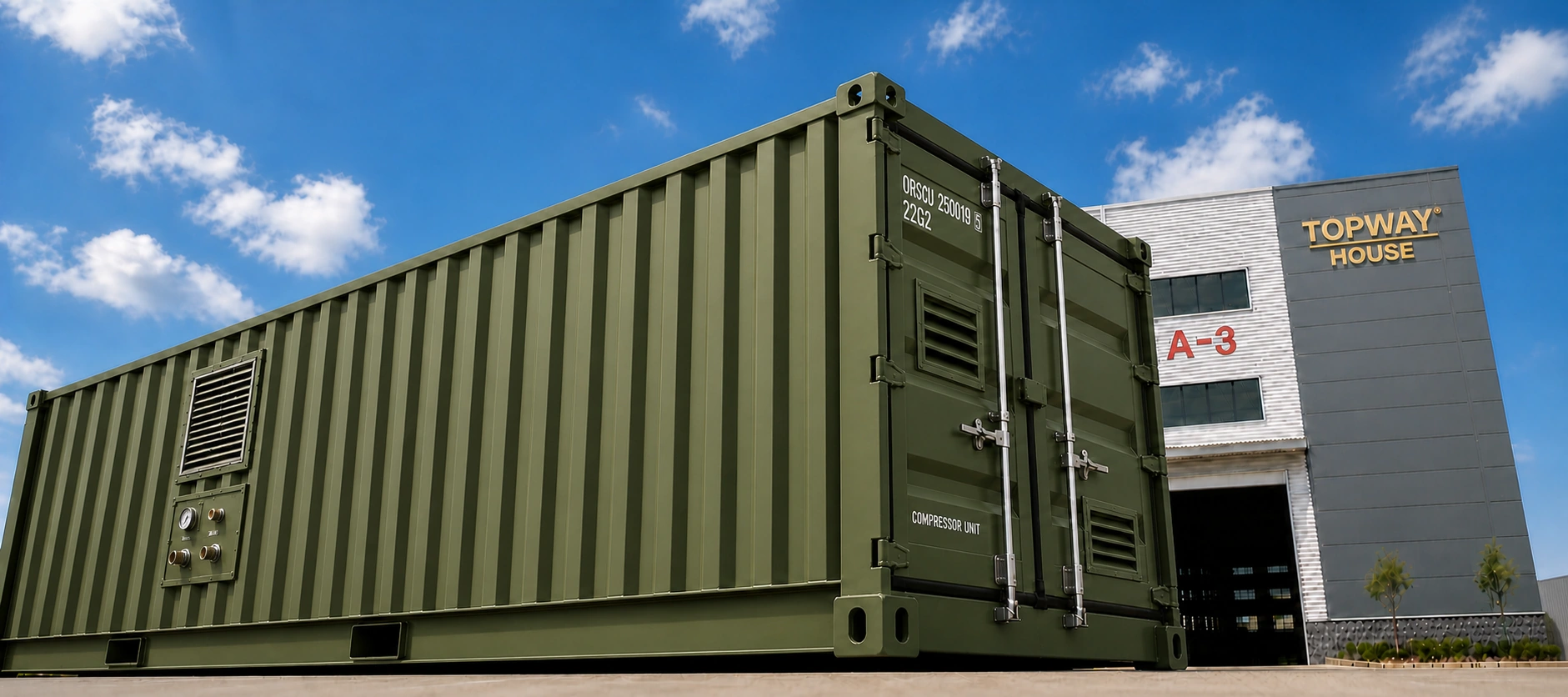 Explore in 3D
01 / Applications
Equipment Container Applications
An equipment container can bring an industrial system into a dedicated enclosure. The starting point is the equipment arrangement, rather than an assumed standard box. Share the equipment drawings, maintenance clearances and site conditions so the enclosure can be reviewed around the actual application.
Heat, noise, vibration, environmental exposure and safety requirements vary by application. Required performance, applicable standards and verification responsibilities must be agreed for the specific project.
02 / Configuration
Equipment Container Customization Options
Dimensions & internal layout
Set the enclosure envelope around equipment footprints, working aisles and removal routes. Transport dimensions and on-site unloading conditions should be considered before the layout is finalized.
Base frame & equipment supports
Provide equipment weights, support locations and mounting details. Base-frame reinforcement, foundations and vibration-isolation provisions are reviewed against the agreed loads; no universal load rating is assumed.
Doors & maintenance access
Position personnel doors, equipment openings and service panels around inspection and replacement needs. Confirm clear opening sizes, opening direction, locking arrangements and access to serviceable components.
Ventilation & cooling interfaces
Coordinate louvers, ventilation openings and air-conditioning interfaces with the equipment supplier’s heat-release and airflow requirements. Cooling equipment selection and thermal performance are project-specific, not implied by an opening alone.
Electrical & piping connections
Identify cable entries, pipe penetrations and equipment connection points early. Confirm their locations, sizes, sealing details and responsibility for installation, wiring, piping and commissioning.
Insulation & surface protection
Discuss insulation, weather sealing and corrosion-protection requirements for the installation environment. Materials, finishes and any required protection or fire-performance criteria are confirmed during technical review.
03 / Supply boundary
Equipment Container Supply Scope
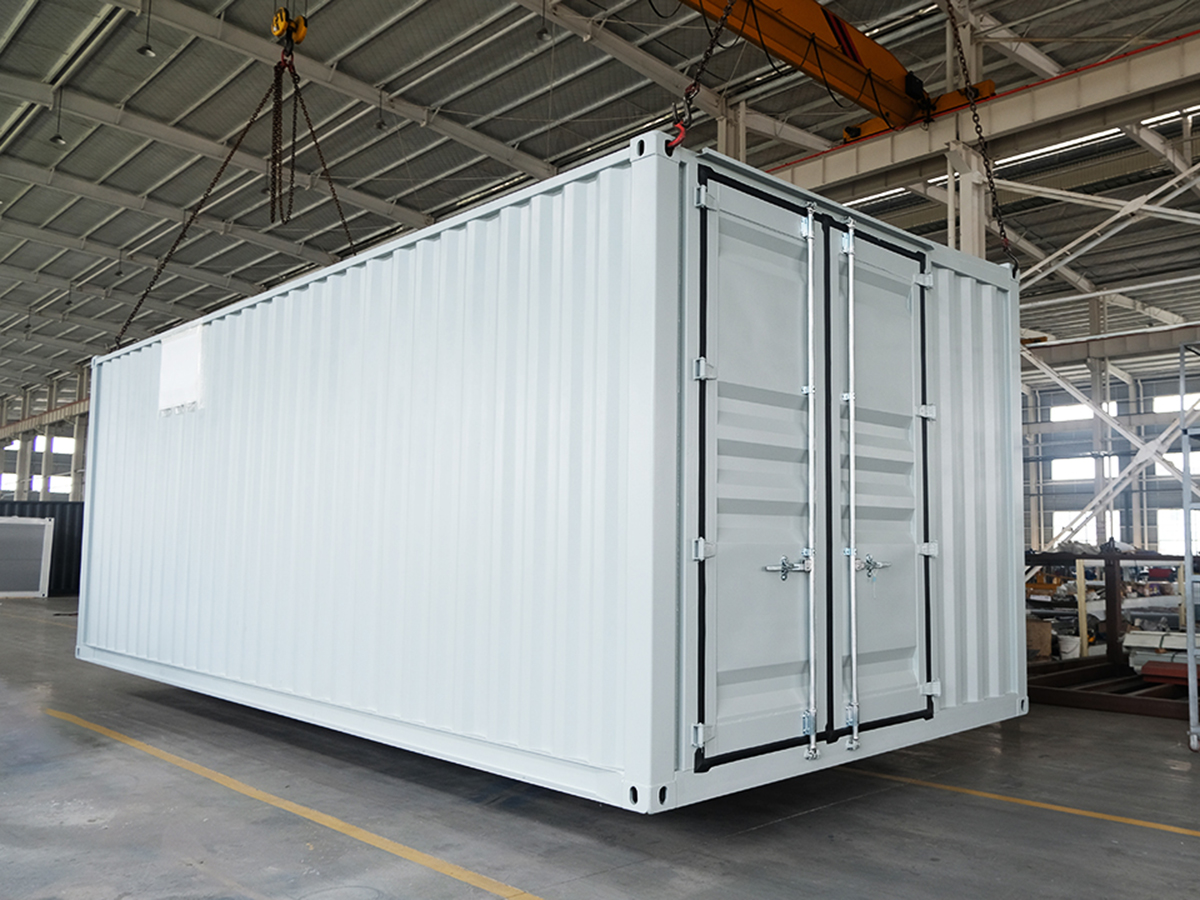
The starting scope is the container body, structural provisions and agreed interfaces.
Equipment shown or discussed is not automatically included. Process machinery, electrical systems, cooling units, controls, fire-protection systems and commissioning must each be explicitly identified in the quotation and technical agreement.
Agree who supplies and installs each component, who verifies system performance, and what drawings or inspection records are required. This keeps enclosure manufacture and equipment integration aligned.
04 / Engineering brief
Engineering Information for Equipment Container Selection
A preliminary layout is enough to start a discussion. Provide the equipment envelope, operating weight and load at each support point, together with maintenance clearances and the route for removing major components. Mark unknowns clearly for engineering review rather than treating them as fixed specifications.
Provide equipment heat-release data and the intended airflow path so ventilation and cooling interfaces can be coordinated with the equipment supplier. Identify the destination, transport limits, lifting points to be reviewed and available unloading equipment. These inputs inform project-specific engineering; they do not establish a standard capacity or performance rating.
Use a clearly identified drawing revision for review. Agree the approval process and discuss the required delivery documents, such as approved layout and interface drawings, material or finish information, and agreed inspection records. Document availability and scope, dimensions, price and delivery arrangements must be confirmed for the project.
- Equipment: type, drawings, dimensions, weight, mounting points and service clearances.
- Operation: heat release, airflow, noise, vibration and any hazardous conditions.
- Site: location, indoor or outdoor use, ambient conditions and required protection.
- Connections: cable and pipe schedules, access positions and equipment-supplier requirements.
- Delivery: quantity, destination, transport constraints, unloading plan and target schedule.
- Scope: supply responsibilities, applicable standards, inspection needs and approval drawings.
05 / Questions
Equipment-container procurement FAQ
Can you work from our equipment drawings?
Yes. Equipment layouts and interface drawings provide the basis for reviewing the enclosure. Include maintenance and replacement clearances, not only the operating footprint.
Is the equipment included in the container price?
Do not assume it is. The quotation should separate the container body and agreed interfaces from machinery, electrical installation, cooling and other systems. Inclusion requires explicit project agreement.
What dimensions and load capacity are available?
These are confirmed after reviewing equipment loads, geometry, transport and installation requirements. A photograph or previous configuration does not establish a standard capacity for your project.
Does the enclosure come with a standard certification?
Required standards, testing and documentation must be specified and agreed for the project. This page makes no blanket certification, ingress-protection or fire-rating claim.

Pip is here to help.
Ready for technical review?
Tell us about your equipment.
Send your layout, equipment details and required supply scope. We can use them to discuss a practical enclosure configuration and the questions that need resolving.Share your layout, equipment details and required supply scope.
Send Your Equipment RequirementsRequest a Quote